



Best Website Builder
I test every website builder so you don’t have to. These are my rankings of the best website builders for 2026.
Our work is supported by affiliate commissions. Learn More
Our work is supported by affiliate commissions. Learn More
By Steve Benjamins | Updated Sep 24 2026
“Map maker” means very different things to different people.
A store locator for your website, a dungeon for Friday’s D&D session and a printable map for a wedding invitation all need different tools. Pick the wrong one and you’ll spend an afternoon fighting software that was never built for what you’re doing.
So this roundup is organized by the kind of map you want to make. Each tool gets a short description, what it’s best for, what it costs and where it falls short.
One disclosure up front: I’m a co-founder of Atlist, which is in this list. I’ve tried to be clear about where it fits, and where it doesn’t. (It’s not the tool for printable maps or fantasy worlds, for example.)
| Map maker | Best for | Free option | Paid from | Embed on a website | Export |
|---|---|---|---|---|---|
| Atlist | Custom map on your website | Yes (personal use, no embedding) | $15/mo | Yes | CSV |
| Free Map Maker | Quick one-off maps | Free, no signup | — | No | Screenshot |
| Google My Maps | Free maps with routes and layers | Free | — | Yes | KML/KMZ |
| Scribble Maps | Drawing and annotating on a map | Yes (5 maps) | $14/mo | Yes | Image |
| Mapme | Interactive business maps | 14-day trial | $30/mo | Yes | — |
| Create a Clickable Map | Clickable state and region maps | Yes (with credit link) | $37 once | Yes | — |
| Inkarnate | Fantasy world and regional maps | Yes (2K export) | $25/yr | No | Image |
| Wonderdraft | Fantasy world maps (desktop) | No | $29.99 once | No | Image |
| Dungeondraft | D&D battle maps | No | $19.99 once | No | Image, VTT |
| Dungeon Alchemist | Fast 3D battle maps | No | $44.99 once | No | Image, VTT |
| Azgaar’s Fantasy Map Generator | Generating whole fantasy worlds | Free (open source) | — | No | SVG, PNG |
| Dungeon Scrawl | Free dungeon maps in a browser | Yes (no signup) | $5/mo | No | PNG, WebP |
| Canva | Printable map graphics | Yes | $144/yr | No | PNG, JPG, PDF |
| MapChart | Coloring countries and states | Free | Plus (paid) | No | Image |
| Mapcreator | Pro print and video maps | Yes | €99/mo | Yes | SVG, EPS, PNG, MP4 |
| BatchGeo | Spreadsheet to map, fast | Yes (ads, limits) | $99/mo | Yes | — |
| Maptive | Business data analysis | 10-day trial | $110/mo | Yes | Image |
| Datawrapper | Data maps for articles | Yes | $21/user/mo | Yes | PNG (SVG, PDF paid) |
| Google Maps Platform | Custom maps in code | Free monthly usage | Pay as you go | Yes (code) | — |
| Mapbox Studio | Fully custom map design | 50,000 loads/mo | Pay as you go | Yes (code) | — |
| QGIS | Free desktop GIS | Free (open source) | — | No | PDF, SVG, image |
| ArcGIS Online | Professional GIS | No | $100/yr (personal use) | Yes | Many formats |
Prices as of September 2026. Annual-billing prices are shown where a tool offers them.
Best for: embedding a custom, branded Google Map with lots of markers.
I’d suggest Atlist if you want a custom Google Map with multiple markers on your website: a store locator, a map of properties, a travel map or a directory.
Now I should mention: I’m a co-founder of Atlist, so weigh that accordingly. Our goal was to make creating a custom map as easy as writing a Word document. You can see an example in this map of NBA teams.

Atlist is easy to use and intuitive.
Here’s what it does well:
Price: There’s a free plan for personal use (5 maps, 50 markers per map, no sharing or embedding). Basic is $15/month (100 markers per map, 1,000 map views per month included). Pro is $25/month (1,000 markers per map, 2,000 views, routes and Google Sheets sync). Views beyond your plan cost $0.009 each.
Watch out for: Atlist isn’t built for printable maps. Export is CSV only, so for print you’d take a screenshot. And because pricing is based on views, a high-traffic map costs more than a quiet one.
Best for: a one-off map you need in the next five minutes.
Free Map Maker is a simple, free tool (made by the Atlist team) for drawing on a Google Map. Drop markers or search for an address, draw routes, polygons and circles, and add arrows, emojis, text or freehand paint. You can switch between roadmap and satellite views.
There’s no account to create. Open it and start drawing.
Free Map Maker lets you draw markers, routes and shapes without signing up.
Price: Free.
Watch out for: It doesn’t save your map. When you’re done, you take a screenshot. There’s no share link or embed either, so if you need those, you’ve outgrown it.
Best for: free maps with routes, layers and measurements.
Google My Maps is free, familiar and more capable than it looks. It’s best for adding markers and creating custom routes (driving, biking or walking) between them, organized into layers. I find it especially useful for planning biking and walking routes:
Adding several routes as layers in Google My Maps.
It also has a good measuring tool. You can measure distances, or draw a polygon to get the area of a park or a property.
Using Google My Maps to measure the size of a park.
You can import CSV, Excel, KML or GPX files or a Google Sheet, up to 2,000 rows per import and up to 10 layers per map.
Price: Free.
Watch out for: Styling is limited. Markers are restricted to Google’s icon set and color palette, you can’t redesign the pop-ups, and embedded maps come with a Google header bar you can’t restyle.
Styling is limited: you can't even change the color of the header bar.
Our roundup of Google My Maps alternatives covers tools that fix this. New to My Maps? Start with our Google My Maps tutorial.
A note on the name: My Maps is not the old “Google Map Maker.” Google Map Maker was a separate service for editing Google Maps itself (adding roads, businesses and so on), and Google shut it down in 2017.
Best for: marking up a map with shapes, lines and text.
Scribble Maps is a drawing-first map maker. You sketch shapes, lines, text and markers on top of a map, then share it, embed it or export it as an image. Paid plans add data import, heatmaps and larger exports.
Price: The free plan includes 5 maps, the drawing tools and 450×450 px image exports. Pro Basic is $14/month billed annually ($19 month-to-month) and adds unlimited maps, heatmaps and 2,500×2,500 px exports. There’s also a $24.99 pass that unlocks Pro Basic for 21 days.
Watch out for: The free image export is tiny. 450 pixels square isn’t usable for print or most web layouts.
Best for: polished interactive maps with categories and media.
Mapme makes interactive maps with categories, media galleries, custom markers and map styles. Think real estate developments, campus maps and event maps. Higher tiers add data import, Google Sheets integration, printing and team collaboration.
Price: There’s no free plan, only a 14-day trial (limited to 5 locations and 100 map views). Starter is $30/month billed annually ($50 month-to-month) and allows 30 locations per map. Professional ($55/month billed annually) raises that to 300 and adds data import.
Watch out for: The location limits are low for the price. If you have more than a few dozen locations, you’ll need the Professional plan or higher.
Best for: a map where clicking a state or region opens a link.
You’ve probably used a clickable map before. You hover over a state, it highlights, and clicking it takes you to a page:
I'm hovering over South Dakota.
These are surprisingly tricky to build. Create a Clickable Map (CACM) makes it easy: pick a map, set a color and link for each region, then paste the embed code into WordPress, Wix, Squarespace, Shopify or any site that accepts custom code. Maps include US states, US counties, congressional districts, Canada, Mexico, the UK, Australia, the continents and the world.
CACM is the easiest way to create clickable maps.
Price: Free with a link back to CreateAClickableMap.com. A one-time $37 payment removes the link and lets you keep editing.
Watch out for: It’s region-based. It’s great for “click your state,” but it won’t plot individual addresses.
Best for: world and regional maps for D&D, RPGs and novels.
A quick note on fantasy maps: they split into two jobs. World and regional maps show continents, kingdoms and coastlines. Battle maps show dungeons, taverns and caves on a grid for your table or virtual tabletop. Most tools are good at one or the other, not both.
Inkarnate is a browser-based fantasy map maker for dungeon masters, authors and tabletop RPG makers. It’s the best fantasy map maker I’ve tried. It’s easy to learn, and the included art is excellent. Here’s what the map editor looks like:
Inkarnate is an easy-to-use tool for creating fantasy maps like this.
You can also create interiors and dungeons:
Inkarnate even lets you create interiors and dungeons.
Price: The free version includes a small selection of art, exports up to 2K resolution and a personal-use license. Pro is $5/month or $25/year and unlocks the full art library and high-resolution exports.
Watch out for: It’s strongest for world and regional maps. If you’re building big dungeons with lots of rooms, a dedicated battle map tool like Dungeondraft is faster.
Best for: detailed regional and world maps with a one-time purchase.
Wonderdraft is desktop software for Windows, Mac and Linux. You generate a landmass, then paint mountains, trees and rivers, draw roads and add labels. There’s a large community of free and paid asset packs to extend it.
Price: $29.99, one-time.
Watch out for: There’s no free version, and it’s desktop only, so you can’t work from a browser or a tablet. It’s also built for world and regional maps, not battle maps. Dungeondraft, from the same developer, covers those.
Best for: dungeons, buildings and caves on a grid.
Dungeondraft is built for battle maps. You draw rooms and walls, drop in doors, furniture and lighting, or start from its built-in dungeon and cave generator. Finished maps export for printing or for virtual tabletops.
Price: $19.99, one-time, for Windows, Mac and Linux. You don’t need an extra license to sell maps you make with it.
Watch out for: It’s desktop only, and there’s no free version to try first.
Best for: DMs who want a good-looking map in minutes.
Dungeon Alchemist furnishes rooms for you. You draw a room and pick a theme, and it places walls, floors, objects and lighting automatically, in 3D. You can tweak anything it generates, then export the map for printing, sharing or a virtual tabletop.
It uses its own procedural algorithms and artist-made assets, not generative AI.
Price: $44.99 on Steam.
Watch out for: You trade some control for speed. If you have an exact layout in mind, expect to spend time adjusting what it generates.
Best for: generating a detailed fantasy world instead of drawing one.
Game masters who don’t want to draw a world from scratch can use Azgaar to generate one: continents, rivers, political states, cultures, religions, towns and trade routes, even heraldry. Then you can edit all of it, adding labels, markers and more.
Using Azgaar, the fantasy map generator.
Price: Free and open source. It runs in your browser.
Watch out for: There’s a lot of interface. Expect to spend some time learning where everything is.
Best for: quick, clean dungeon maps in your browser.
Dungeon Scrawl is a free, browser-based dungeon map maker with no download or signup. You draw rooms and halls with shape tools, add props and markers, or import a map from a random dungeon generator. It supports square grids, hex grids and isometric maps, and exports PNG or WebP.
Price: Nearly everything is free. Pro is $5/month and adds cloud saving, shareable links, PDF and high-resolution export, lighting effects and a commercial-use license.
Watch out for: The look is clean and old-school rather than painterly. That’s great for readability at the table, less so if you want a showpiece map.
Best for: maps that are part of a flyer, invitation, presentation or post.
If your map is going on paper, a slide or a social post, you want a tool that exports a clean, high-resolution image, not an interactive web map.
Canva has map templates and its familiar drag-and-drop editor. Pick a template, add pins, arrows, labels and colors, and drop the map into the rest of your design. If the map is one part of a bigger graphic, this is the easiest way to do it.
Price: Free plan. Canva Pro is $144/year for one person, or $18/month billed monthly.
Watch out for: The result is a static graphic. There’s no zooming, clicking or accurate address plotting like you’d get from a web map.
Best for: color-coded maps of countries, states or regions.
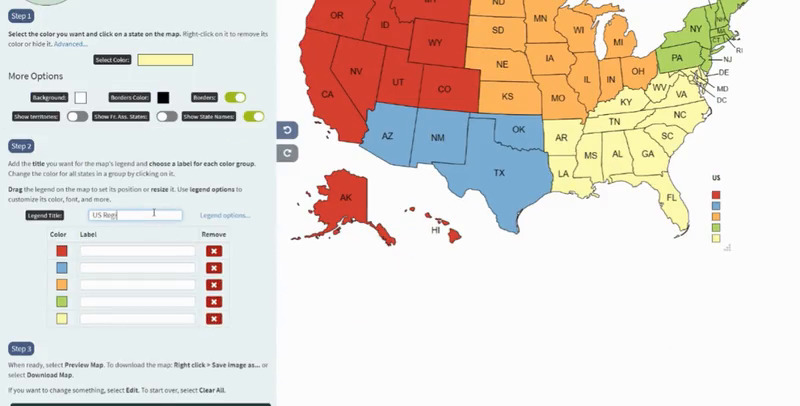
MapChart is simple. Click a country or region, choose a color, fill in the legend and download a high-resolution image. There are maps of the world, continents, US states and counties, and more, plus options for patterns, borders and hiding regions you don’t need.
This video shows it perfectly:

Price: Free, with a paid Plus version for advanced features. Maps you make are licensed under Creative Commons (CC BY-SA 4.0), so you can use them commercially as long as you credit MapChart.
Watch out for: It colors regions. It doesn’t plot addresses or make interactive maps.
Best for: publication-quality maps for newsrooms, tourism and real estate.
Mapcreator makes maps you export as images, vector files and even video. It’s often used by newsrooms, real estate, government and tourism companies. You can export PNG, JPG, SVG and EPS with CMYK colors for print, MP4 and MOV video, or interactive web maps. It imports GeoJSON, GPX, KML, Excel and CSV.
Here are a few example maps:
Example maps made with Mapcreator.
Price: There’s a free plan to get started. Paid plans start at €99/month (Personal), and the team plan is €699/month.
Watch out for: It’s priced for professionals. For a one-off printable map, Canva or MapChart will do.
Best for: a fast map from a list of addresses.
If your locations live in a spreadsheet (customers, stores, sales territories), the next three tools turn rows into a map and help you analyze it. Atlist and Google My Maps also import spreadsheets; these tools go further on the data side.
BatchGeo is about as quick as mapping gets. Paste your spreadsheet rows (addresses or coordinates) and you have a map in seconds.
Price: The free version shows ads and has tight limits (up to 250 locations and 100 map views). Pro is $99/month: 25,000 markers per map, no ads, password protection and up to 10 team members.
Watch out for: The free version is for a quick look at your data, not a public-facing map. The ads and view limits get in the way.
Best for: businesses analyzing sales, customers or territories.
Maptive is a business mapping tool with more than 60 tools, including heat maps, territories, radius and route tools, and built-in census data. It handles up to 200,000 markers per map, and you can share, embed or export your maps.
Price: 10-day free trial, no credit card required. A 45-day pass is $250. Pro is $1,250/year, or $110/month billed monthly.
Watch out for: It’s overkill (and expensive) for a simple store locator.
Best for: clean, embeddable data maps for articles and reports.
Datawrapper makes charts, tables and maps: choropleth maps (regions shaded by value), symbol maps and locator maps. It’s popular with newsrooms, and the free plan lets you create interactive maps and embed them on your site.
Price: Free, with PNG export only. Pro is $21 per user per month and adds SVG and PDF export.
Watch out for: It’s built for presenting data, not for pins with pop-ups, photos and directions.
Best for: developers building maps into a website or app.
If you’re comfortable writing code, Google Maps Platform is where to start for a powerful custom map. It gives you APIs for interactive maps, places search, geocoding (turning addresses into coordinates), routes, static map images and more. No-code tools like Atlist run on these same APIs behind the scenes.
It has a learning curve, but Google Maps Platform is great for powerful, custom maps.
You’ll need an API key to start. Here’s how to get a Google Maps API key, and here are 17 Google Maps API examples for inspiration.
Price: Pay as you go. Google replaced its old $200 monthly credit with free monthly usage for each product: 10,000 free calls per month for each Essentials product (5,000 for Pro products and 1,000 for Enterprise products).
Watch out for: It’s a developer platform. Expect code, billing setup and API key management. If you just want a styled map with pins on your site, a no-code tool is much faster.
Mapbox is like Photoshop, but for maps.
Learning Mapbox Studio is roughly like learning Adobe Photoshop or Premiere: expect it to take time. The upside is some of the most powerful map styling of any tool here, down to individual roads, labels and water. For example, Mapbox is used in those fancy Vox videos on YouTube.
Mapbox Studio allows you to get granular with map styles.
Mapbox doesn’t use Google’s map data. It builds its maps largely from OpenStreetMap, a free, open-source map of the world, so an address search can return different results than it would on Google Maps. Mapbox also competes with Google in selling mapping APIs to developers. Mapbox Studio is its design tool.
Mapbox Studio's editor.
Price: The free tier includes up to 50,000 web map loads per month. After that, it’s pay as you go.
Watch out for: It’s overkill for a simple map of your store locations, and publishing a Studio map on your website generally means working with Mapbox’s developer tools.
Best for: real GIS work without paying for a license.
QGIS is free, open-source desktop GIS software for Windows, Mac and Linux. You can load shapefiles, GeoJSON, satellite imagery and other geographic data, run spatial analysis, and design print-quality maps with its layout tools, exporting to PDF, SVG or images.
Price: Free.
Watch out for: It’s a real GIS, with a steep learning curve. If you just need pins on a map, it’s the wrong tool.
Best for: organizations doing serious GIS work.
Esri’s ArcGIS is the industry standard for professional GIS, used by governments, utilities and large organizations. ArcGIS Online is its cloud platform for building maps, web apps, dashboards and story maps, with access to Esri’s Living Atlas library of ready-made geographic data.
Price: ArcGIS for Personal Use (noncommercial only) is $100/year and includes ArcGIS Pro and ArcGIS Online. Commercial licenses are priced per user; contact Esri for a quote.
Watch out for: It’s priced and designed for organizations. For personal projects, QGIS does most of the same work for free.
Answer these five questions and the list gets short fast.
It depends on the map. For a custom map on a website, Atlist. For free, general-purpose maps, Google My Maps. For fantasy and D&D world maps, Inkarnate. For printable maps, Canva. For professional GIS, QGIS (free) or ArcGIS.
For real-world maps, Google My Maps. It's free, handles routes and layers, and you can embed it on a website. For a quick map with no signup, try Free Map Maker. For color-coded country or state maps, MapChart. For fantasy maps, Azgaar (worlds) and Dungeon Scrawl (dungeons) are free.
For world and regional maps, Inkarnate (browser-based, with a free version) or Wonderdraft (one-time purchase). For battle maps, Dungeondraft gives you the most control, Dungeon Alchemist is the fastest and Dungeon Scrawl is the best free option.
Use a tool that exports a high-resolution image or PDF. Canva is easiest for maps that are part of a larger design, MapChart is best for color-coded regions, and Mapcreator is the professional option with vector and CMYK exports. Interactive web map tools, including Atlist and Google My Maps, aren't designed for print.
Use a map maker with an embed option, like Atlist or Google My Maps. Add your locations (or import a spreadsheet), style the map, then copy the embed code into your site. Here's our step-by-step guide to mapping multiple locations on Google Maps.
Google Map Maker was a crowdsourced tool for editing Google Maps itself: adding roads, businesses and landmarks. Google shut it down in 2017 and folded editing into Google Maps. If you want to make your own custom map with Google, the tool you're looking for is Google My Maps.
Yes. BatchGeo is the fastest (paste your rows and you're done), Maptive is best for business analysis, and Atlist and Google My Maps both import CSV and Excel files. Atlist's Pro plan can also sync with a Google Sheet.
QGIS if you want free and open source, ArcGIS if your organization needs the industry standard. Both have a steep learning curve compared with everything else on this list.